
AR402 | BUILDING CONSTRUCTION & MATERIALS–VII | UNIT II

CHAPTER 2 MODERN CONSTRUCTION EQUIPMENT
2.1 Introduction to Modern Construction Equipment
Modern construction equipment comprises powered machines and portable tools used for excavation, earthmoving, lifting, material handling, transport, drilling, breaking, measurement and finishing. Mechanisation can increase productivity and repeatability, but safe outcomes depend on equipment suitability, maintenance, trained operators and well-planned site logistics.
Evolution and significance
- . Manual tools and animal-assisted construction preceded steam and internal-combustion machinery.
- . Hydraulic and electric systems enabled greater force, control and precision.
- . Contemporary machines may incorporate sensors, GNSS positioning, telematics and automated guidance.
- . Equipment choice affects construction methodology, site access, component size, duration, cost and safety.
2.2 Classification of Construction Equipment
Primary function | Equipment | Typical work |
Cutting, drilling and fastening | Electric hand tools | Interior and building installation |
Lifting | Cranes | Steel, formwork and precast erection |
Excavation | Excavators, trenchers | Basements, foundations and services |
Earthmoving | Bulldozers, scrapers | Site grading and haulage |
Material handling | Forklifts, dumpers | Storage and loose material movement |
Alignment | Laser line levels | Partitions, ceilings and finishes |
Rock drilling and breaking | Drifters, jackhammers, breakers | Rock and concrete removal |
Continuous transfer | Conveyors | Aggregates and cementitious materials |
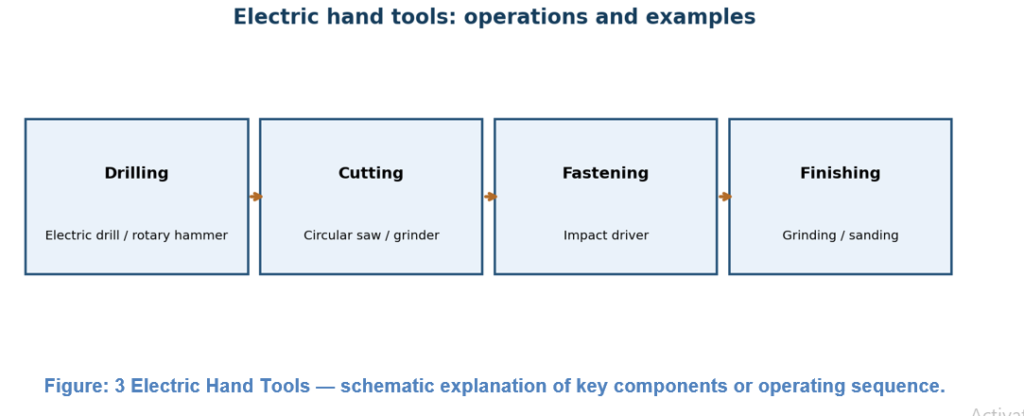
2.3 Electric Hand Tools
Portable corded or battery-powered tools used for drilling, cutting, fastening and surface preparation. Typical components are the motor, transmission, working attachment, trigger and protective guard.
Electric drill
Rotating bit creates holes in timber, metal or other suitable substrates.
Hammer drill / rotary hammer
Combined rotation and impact facilitates masonry or concrete drilling.
Angle grinder
Abrasive or cutting disc performs grinding, cutting or surface preparation.
Circular saw
Rotating toothed blade cuts timber and compatible boards.
Impact driver
Rotational impact assists installation of screws and suitable fasteners.
Applications, selection and safety
- . Check guards, attachments, power leads and batteries before operation.
- . Use material-compatible bits/discs and dust extraction where required.
- . Control kickback, electric shock, vibration and airborne particles.
2.4 Cranes
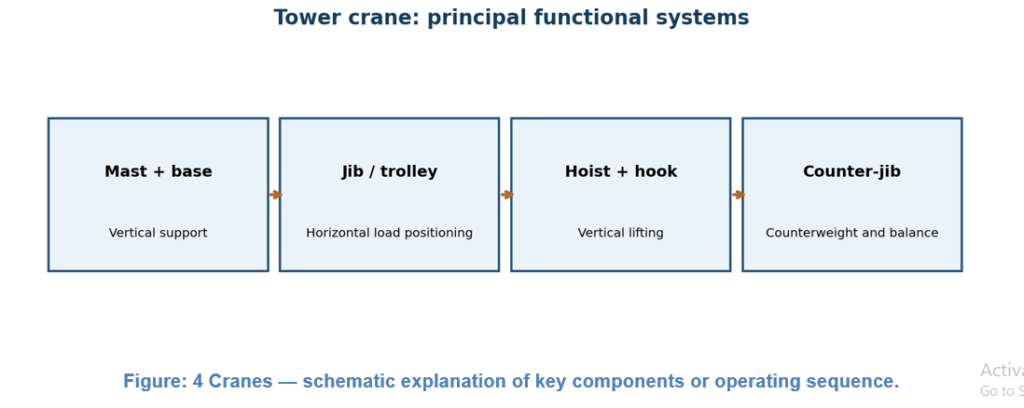
Cranes raise, lower and position heavy loads through hoisting and controlled movement. Lifting capacity depends on configuration, load radius and operating conditions.
Tower crane
Mast-supported machine with jib, counter-jib, hoist and slewing system; common in high-rise construction.
Mobile crane
Wheeled or truck-mounted crane for flexible lifting and relocation.
Crawler crane
Track-mounted machine suited to heavy lifting on properly prepared ground.
Gantry crane
Lifting bridge supported by legs, often used in precast yards and industrial facilities.
Applications, selection and safety
- . Determine load weight, lift height, radius, ground support and obstructions.
- . Consult the manufacturer load chart and use an engineered lifting plan when required.
- . Establish exclusion zones; do not move suspended loads over personnel.
2.5 Excavators
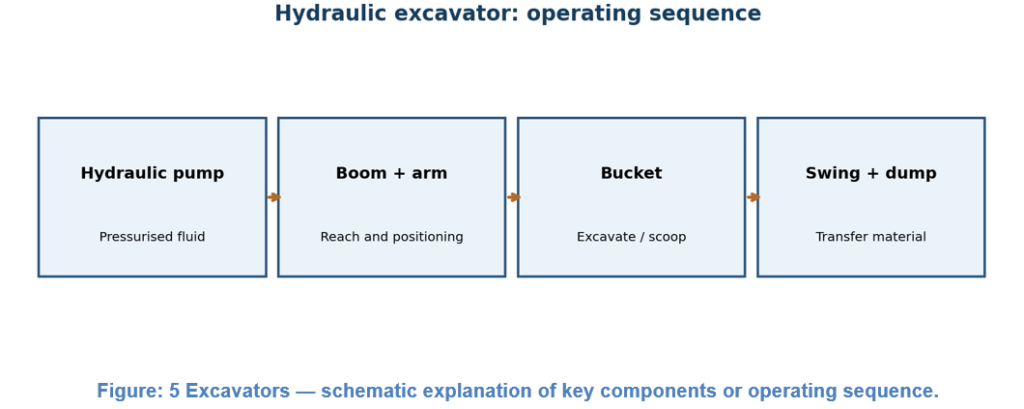
Hydraulic excavators use a boom, arm and bucket driven by hydraulic cylinders, mounted on a rotating upper structure with tracks or wheels.
Crawler excavator
Track-mounted general excavation machine.
Wheeled excavator
Mobile machine for prepared access routes.
Mini excavator
Compact unit for constrained sites.
Long-reach excavator
Extended front equipment for specialised reach requirements.
Applications, selection and safety
- . Applications: basement and foundation excavation, loading, landscaping and demolition with approved attachments.
- . Locate underground services; provide excavation support and protect edges.
. Select bucket capacity and machine reach for soil type and required production.
2.6 Trenchers
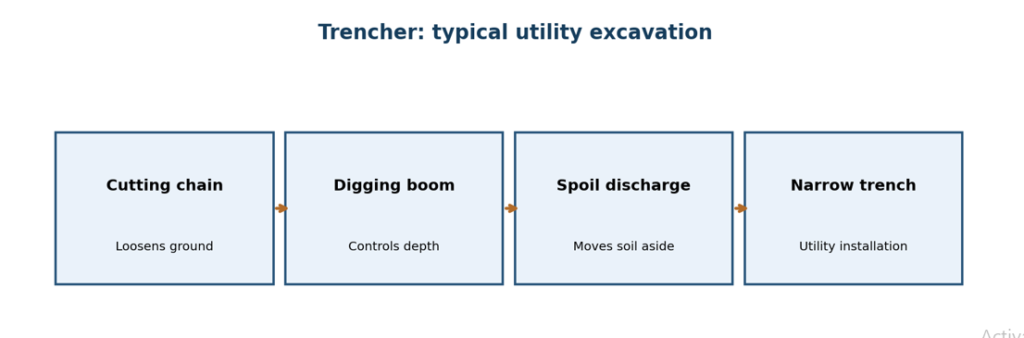
A trencher excavates a relatively narrow, consistent-width cut for pipes, cables and other buried services.
Chain trencher
Cutting teeth mounted on a moving chain dig along a boom.
Wheel trencher
Rotating toothed wheel cuts soil or suitable rock.
Micro trencher
Produces narrow cuts for selected communication cable installations.
Applications, selection and safety
- . Applications: drainage, water, power and telecommunications routes.
- . Check existing utilities, trench stability, required depth and ground conditions.
- . A trencher is not a substitute for protective systems where personnel enter excavations.
2.7 Bulldozers, Scrapers and Earthmoving
Bulldozers push and spread material with a front blade; scrapers cut, collect, haul and discharge soil using a bowl and cutting edge.
Bulldozer
Track- or wheel-mounted; straight, universal, semi-universal and angle blades support different grading tasks.
Scraper
Towed or self-propelled; efficient for selected large-area cut-and-fill operations.
Rear ripper
Optional bulldozer attachment for loosening compacted ground.
Applications, selection and safety
- . Bulldozers are suited to short-distance pushing, not long-distance transport.
- . Scraper performance depends on haul distance, material characteristics and available turning area.
- . Control reversing, blind spots, slope stability and dust.
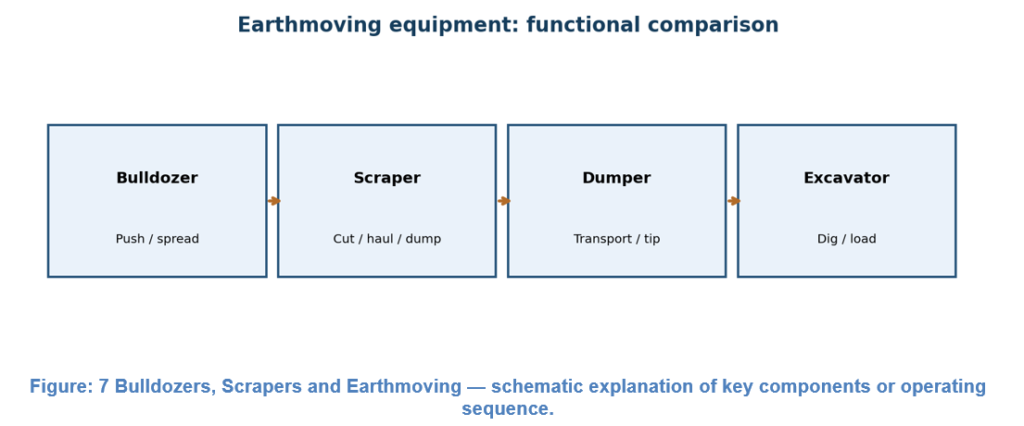
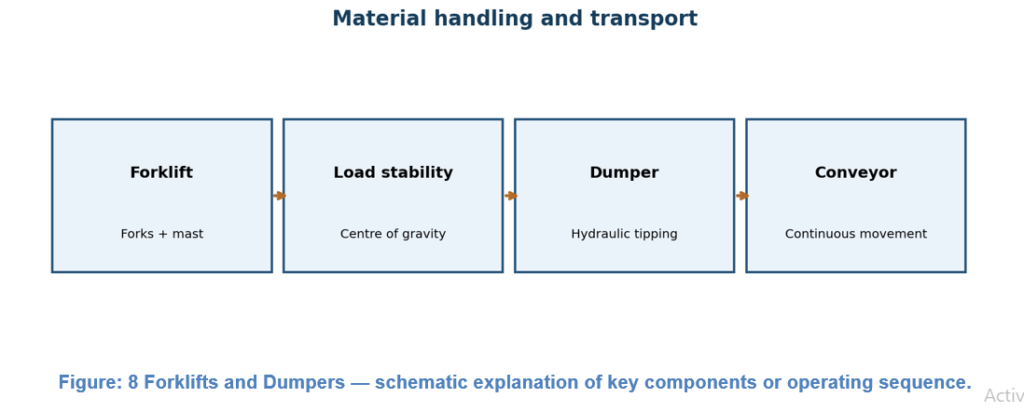
2.8 Forklifts and Dumpers
Forklifts lift and transport palletised loads using a mast and forks; dumpers carry loose materials and discharge them by tipping.
Counterbalance forklift
Mast, forks, carriage, hydraulic lift and counterweight.
Rough-terrain forklift
Designed for specified uneven outdoor conditions.
Site dumper
Compact vehicle for loose material haulage.
Articulated dump truck
Off-road high-capacity haulage with articulated chassis.
Applications, selection and safety
- . Observe rated loads and load-centre requirements for forklifts.
- . Tip dumpers only on suitable stable ground; manage blind spots and pedestrian separation.
. Check haul-route width, gradient, traction and loading area.
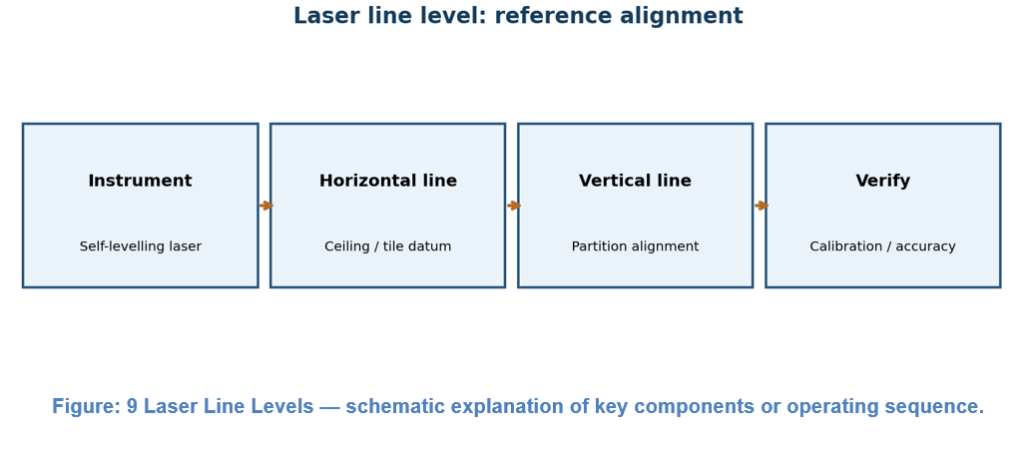
2.9 Laser Line Levels
Electronic instruments that project horizontal, vertical or cross-lines for reference alignment. Some devices self-level within a limited range.
Line laser
Projects a horizontal or vertical datum.
Cross-line laser
Projects intersecting horizontal and vertical lines.
Rotary laser
Generates a reference plane for larger levelling operations.
Applications, selection and safety
- . Applications: ceiling grids, partitions, tiling, cabinetry and setting-out.
- . Verify calibration, reference datum and line visibility.
- . Follow laser-class safety instructions and avoid direct eye exposure.
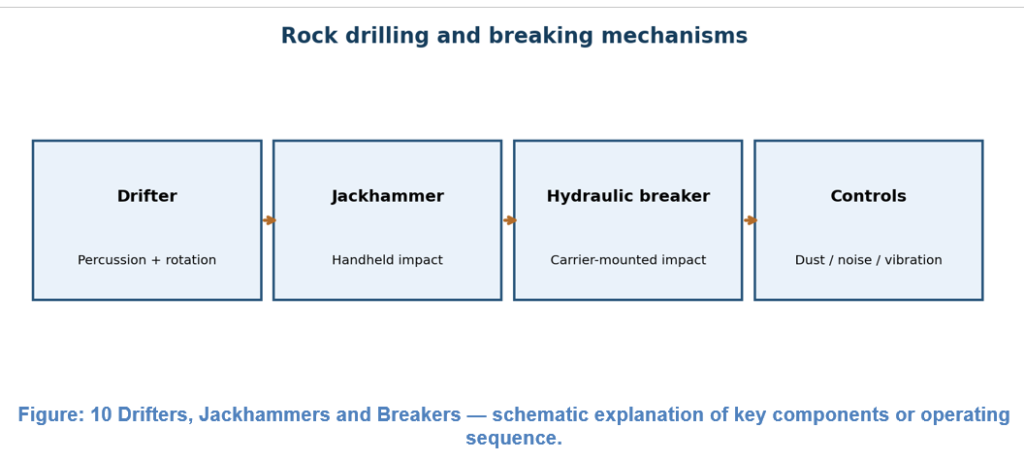
2.10 Drifters, Jackhammers and Breakers
These tools use repeated impact energy for rock drilling or material fracture. Their functions overlap but operating arrangements differ.
Drifter
Rock drill using percussion, rotation and feed; air/water flushing removes cuttings.
Jackhammer
Portable electric, pneumatic or hydraulic impact tool for localised concrete or pavement breaking.
Hydraulic breaker
Typically excavator-mounted impact attachment for heavy rock and concrete breaking.
Applications, selection and safety
- . Select tooling for material strength, work area and available carrier.
- . Manage silica dust, flying fragments, vibration and noise exposure.
- . Confirm stability and structural implications before breaking existing elements.
2.11 Conveyors
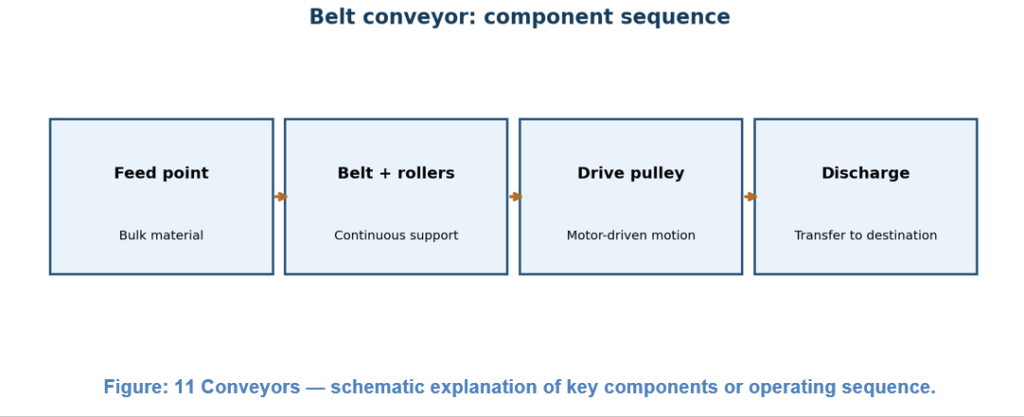
Conveyors transport material continuously along a fixed or semi-fixed route, reducing repeated manual movement.
Belt conveyor
Motor-driven belt supported by pulleys and idlers for aggregates and other bulk materials.
Screw conveyor
Rotating helix in a tube/trough, commonly for cement or powder.
Roller conveyor
Rollers move compatible packages and components.
Bucket elevator
Buckets attached to a belt or chain lift bulk materials vertically.
Applications, selection and safety
- . Assess material type, flow rate, route, inclination and discharge arrangements.
- . Guard moving components and provide accessible emergency stops.
- . Control dust and maintain belt tracking and pulley condition.
2.12 Equipment Selection and Site Planning
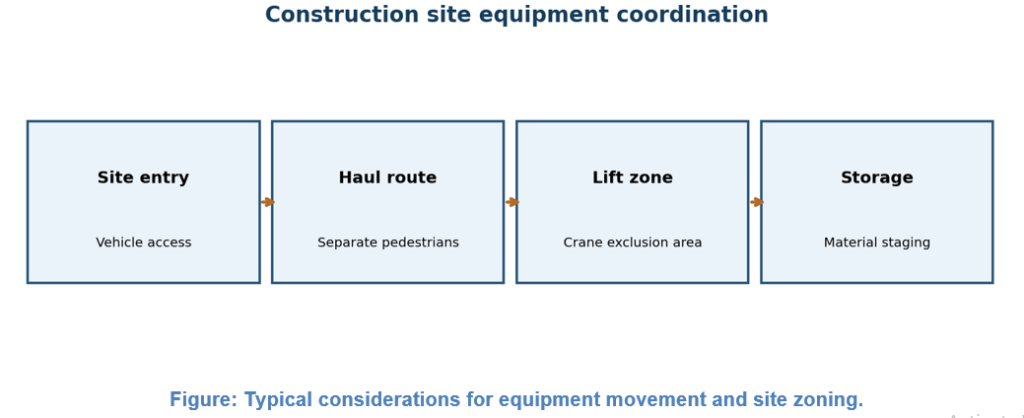
Select machinery by task, productivity, site geometry, ground conditions, lifting or digging requirements, mobilisation, operating costs, environmental constraints and availability of qualified personnel. Architectural site plans should coordinate delivery entrances, haul routes, storage, crane reach, excavation limits, turning areas and protected pedestrian routes
|
Selection criterion |
Key questions |
|
Task |
What operation, material and quantity must be handled? |
|
Capacity |
What load, reach, depth or production rate is required? |
|
Site |
Can the machine enter, manoeuvre and operate on the ground safely? |
|
Cost |
What are rental, mobilisation, fuel, operator and maintenance costs? |
|
Safety |
What utilities, lifting risks, traffic routes and exclusion zones apply? |
|
Environment |
How will dust, noise, vibration and emissions be controlled? |
2.13 Worked Numerical Problems
Problem 1: Excavator productivity
Bucket capacity = 0.8 m³; fill factor = 0.85; cycle time = 30 s; operating efficiency = 75%. Cycles/hour = 3600/30 = 120. Productivity = 0.8 × 0.85 × 120 × 0.75 = 61.2 loose m³/hour. Actual output varies with material and site conditions.
Problem 2: Dumper trips
Loose soil = 120 m³; effective carrying volume = 6 m³/trip. Number of trips = 120/6 = 20. Confirm permissible payload by mass as well as volume.
Problem 3: Conveyor quantity
Average transfer rate = 25 tonnes/hour; operating time = 6 hours. Quantity = 25 × 6 = 150 tonnes.
Problem 4: Equipment utilisation
Available shift = 8 hours; productive time = 6 hours. Utilisation = (6/8) × 100 = 75%.
2.14 Comparative Summary
|
Equipment |
Principal operation |
Common application |
|
Crane |
Lift and position |
High-rise superstructure |
|
Excavator |
Dig and load |
Basements and foundations |
|
Trencher |
Cut narrow trench |
Buried utilities |
|
Bulldozer |
Push and grade |
Site preparation |
|
Scraper |
Cut, haul and discharge |
Large-scale grading |
|
Forklift |
Lift pallets |
Material storage |
|
Dumper |
Haul and tip |
Loose soil transport |
|
Laser level |
Project reference |
Interior setting-out |
|
Drifter |
Percussive rock drilling |
Rock works |
|
Jackhammer / breaker |
Impact fracture |
Demolition |
|
Conveyor |
Continuous transfer |
Bulk material handling |
2.15 Tutorials and Classroom Exercises
Exercise 1: Prepare two A3 sheets identifying five machines with labelled components, working principles, applications and limitations.
Exercise 2: Select equipment for site clearing, basement excavation, soil transport, lifting reinforcement and interior partition installation; justify each selection.
Exercise 3: Draw a conceptual construction site plan showing vehicle circulation, material storage, crane position, unloading, excavation boundaries and exclusion zones.
2.16 Examination-Oriented Questions
Short-answer questions
- . Define modern construction equipment and classify it by function.
- . Identify four electric hand tools and their uses.
- . Name the principal components of a tower crane.
- . Distinguish an excavator from a trencher.
- . State two uses of a bulldozer and scraper.
- . Explain the purpose of a forklift counterweight.
- . What is a laser line level?
- . Differentiate a drifter, jackhammer and hydraulic breaker.
- . Name three conveyor types.
Descriptive questions
- . Explain the types, components and applications of cranes with labelled sketches.
- . Describe hydraulic excavator operation and excavation-site precautions.
- . Compare bulldozers, scrapers and dumpers for earthmoving.
- . Explain forklift and dumper operation, including stability and safety.
- . Discuss drilling and demolition equipment with diagrams.
- . Explain conveyor types and working principles.
- . Describe factors governing equipment selection and site planning.
2.17 Teaching Schedule — 14 Contact Hours
|
Session |
Topic |
Hours |
|
1 |
Introduction, classification and electric hand tools |
2 |
|
2 |
Cranes |
2 |
|
3 |
Excavators and trenchers |
2 |
|
4 |
Bulldozers, scrapers and dumpers |
2 |
|
5 |
Forklifts, conveyors and laser levels |
2 |
|
6 |
Drifters, jackhammers and breakers |
2 |
|
7 |
Selection, site planning, safety, numericals and revision |
2 |
|
Total |
14 |
2.18 Learning Outcomes
- . Identify and classify common construction machinery.
- . Explain the working principles and components of equipment.
- . Compare equipment applications, advantages and constraints.
- . elect appropriate machinery for given construction tasks.
- . nterpret basic productivity calculations and site logistics.
- . Recognise essential operational and site safety requirements.
2.19 Recommended References
- . Peurifoy et al., Construction Planning, Equipment, and Methods, McGraw-Hill.
- . Chudley and Greeno, Building Construction Handbook, Routledge.
- . Sharma, Construction Equipment and Its Management, Khanna Publishers.
- . arris, McCaffer and Edum-Fotwe, Modern Construction Management, Wiley-Blackwell.
- . Relevant manufacturer manuals, load charts, and applicable Indian safety requirements; verify current editions.
Chapter Summary
Modern construction equipment supports excavation, lifting, transport, material handling, surveying, drilling, demolition and finishing. Architects must understand machine functions as well as the implications of equipment capacity, access, sequencing and safety for design and site organisation. The appropriate equipment is that which performs the intended work safely, efficiently and economically under actual site conditions.
How useful was this post?
Click on a star to rate it!
Average rating 0 / 5. Vote count: 0
No votes so far! Be the first to rate this post.


