
UNIT 4: ALTERNATE CONSTRUCTION MATERIALS AND TECHNIQUES

Chapter 4: Overview
This chapter introduces the prescribed alternative and advanced construction materials for Unit IV, covering ferrocement, fly ash bricks, AshCrete, titanium dioxide, foamed concrete, graphene, high-performance concrete, self-compacting concrete, high-volume fly ash concrete, condensed silica fume, self-curing and shrinkage-compensating concrete, translucent concrete, and sandwich panels. Special emphasis is placed on composition, working principle, construction process, architectural applications, advantages, limitations, and material-selection criteria.
Learning outcomes
- . Identify and classify the principal materials included in Unit IV.
- . Explain material composition, production and performance mechanisms.
- . Interpret labelled diagrams of ferrocement, SCC, photocatalytic coatings, internal curing, translucent concrete and sandwich panels.
- . Compare traditional and advanced material technologies in relation to project requirements.
- . Evaluate material choices using structural, environmental, thermal, fire, durability and cost criteria.
Contents
SECTION | TOPIC |
4.1 | Introduction and classification |
4.2 | Ferrocement |
4.3 | Fly ash bricks |
4.4 | AshCrete |
4.5 | Titanium dioxide |
4.6 | Foamed concrete |
4.7 | Graphene-based materials |
4.8 | High-performance concrete |
4.9 | Self-compacting concrete |
4.10 | High-volume fly ash concrete |
4.11 | Condensed silica fume |
4.12 | Self-curing concrete |
4.13 | Shrinkage-compensating concrete |
4.14 | Translucent concrete |
4.15 | Sandwich panels |
4.16–4.23 | Comparative study, material selection, sustainability, exercises, examination questions, timetable and references |
4.1 Introduction to Alternate Construction Materials and Techniques
4.1.1 Meaning and context
The construction industry has traditionally used burnt clay bricks, cement, concrete, steel, timber and natural stone. Increasing emphasis on environmental impacts, resource efficiency, building performance and construction productivity has led to the development and adoption of alternate and advanced construction materials.
Alternate construction materials replace or supplement conventional products to achieve particular technical, environmental or economic objectives. Advanced construction materials are engineered or modified to deliver selected properties such as high strength, reduced weight, improved durability, enhanced workability or specialised surface functions.
For example, fly ash bricks may be an alternative to fired clay bricks, whereas self-compacting concrete represents an advancement in construction and concrete technology.
4.1.2 Reasons for adoption
- . Environmental sustainability: reduce resource demand and impacts where supported by evidence.
- . Resource efficiency: use suitable industrial by-products, secondary raw materials and recycled constituents.
- . Energy efficiency: improve building-envelope performance when used in an appropriate assembly.
- . Structural efficiency: optimise strength, weight and material quantity.
- . Construction efficiency: enable prefabrication, flowability, or rapid assembly.
- . Durability and maintenance: address exposure, deterioration and service-life requirements.
- . Architectural possibilities: enable thin shells, light-transmitting surfaces and multifunctional façades.
4.1.3 Classification
CLASS | MATERIALS |
Alternative masonry | Fly ash bricks |
Cement-based composites | Ferrocement |
Lightweight cementitious materials | Foamed concrete |
Engineered concrete systems | HPC; SCC |
Industrial by-product-rich concrete | HVFA concrete; silica-fume concrete |
Functional materials | Titanium dioxide; graphene-based additives |
Special concrete systems | Self-curing; shrinkage-compensating; translucent concrete |
Composite prefabricated components | Sandwich panels |
Emerging alternate binders | AshCrete / ash-based systems |
4.2 Ferrocement
4.2.1 Definition and working principle
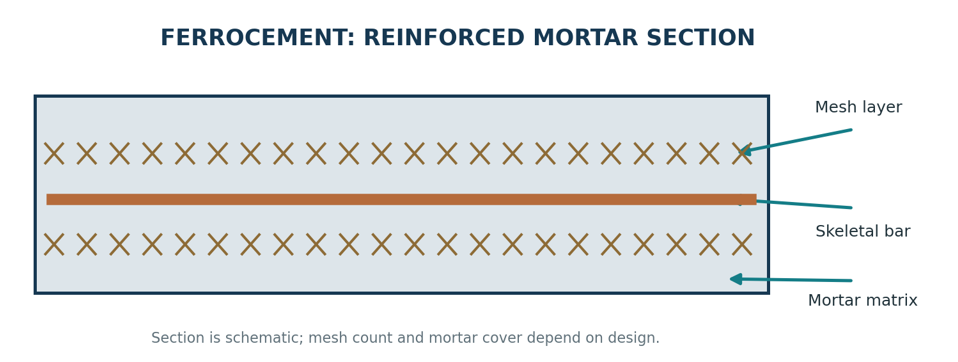
Ferrocement is a thin cementitious composite in which layers of closely spaced reinforcing mesh are embedded in mortar. Unlike conventional reinforced concrete, which normally relies on comparatively large reinforcing bars, ferrocement distributes reinforcement throughout a relatively thin section. The mesh contributes to crack control and tensile and flexural performance.
4.2.2 Composition
Cement. Portland cement or another suitable cementitious binder.
Fine aggregate. Clean, properly graded sand forming the mortar matrix.
Water. Water suitable for mixing and hydration.
Mesh reinforcement. Woven or welded wire mesh or another specified suitable mesh.
Skeletal reinforcement. Small bars or a frame where needed to shape and support the mesh during production.
4.2.3 Typical construction process
- 1. Prepare a framework and establish the desired geometry.
- 2. Fix the mesh layers and support bars, checking cover and spacing.
- 3. Prepare workable mortar with controlled proportions.
- 4. pply or place mortar ensuring full penetration around reinforcement.
- 5. Finish the exposed surfaces as required.
- 6. Cure adequately to reduce early-age cracking and achieve specified performance.
4.2.4 Properties, applications and limitations
Ferrocement permits thin sections and curved forms; mesh reinforcement helps distribute cracking. When appropriately detailed it may be prefabricated for canopies, water tanks, shells, domes and decorative elements. However, quality is sensitive to workmanship, adequate mortar compaction and reinforcement protection.
ADVANTAGES | LIMITATIONS |
Thin, lightweight sections | Careful placement of mesh is necessary |
Curved and complex shapes | Labour-intensive where manually fabricated |
Potential prefabrication | Poor mortar penetration creates voids |
Crack distribution by reinforcement | Inadequate cover may permit corrosion |
4.3 Fly Ash Bricks
4.3.1 Introduction
Fly ash bricks are masonry units manufactured with fly ash as a principal ingredient. Fly ash is a finely divided residue associated with coal combustion and may be collected from power-generation facilities. Incorporation into masonry products can provide an application for suitable industrial by-products and reduce demand for conventional fired clay products.
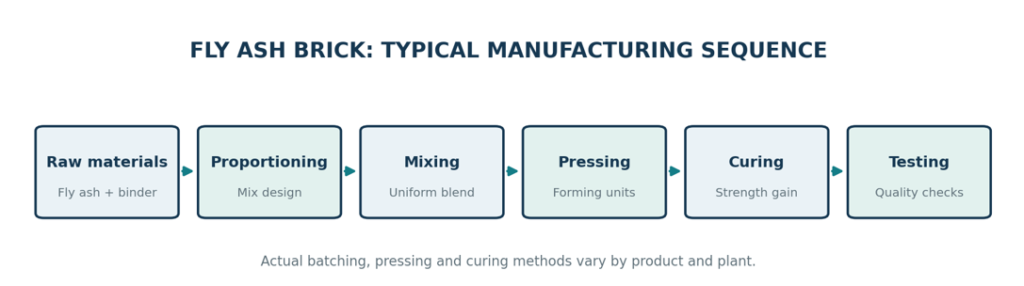
4.3.2 Constituents and production
Common formulations include fly ash, lime or cement, fine aggregate or stone dust, gypsum or other permitted additives, and water. Quantities and manufacturing processes vary by technology. Product properties should be established by tests and manufacturer documentation.
4.3.3 Performance characteristics
- . Often relatively uniform in size when machine-manufactured.
- . Can provide a smooth and regular surface suitable for masonry work.
- . Compressive strength and absorption depend on materials, curing and process control.
- . Dimensional consistency may reduce mortar and finishing demands.
- . Environmental benefits vary with binder content, transport and production energy.
|
PARAMETER |
FLY ASH BRICKS |
BURNT CLAY BRICKS |
|
Main raw materials |
Fly ash with binders and aggregate |
Natural clay |
|
Processing |
Mixing, compacting and curing |
Moulding, drying and firing |
|
Dimensional consistency |
Frequently good with controlled production |
Varies with manufacturing |
|
Strength |
Depends on product grade |
Depends on brick class |
|
Environmental concern |
Ash source, binder and transport |
Clay extraction and firing |
4.3.4 Architectural use and specification
Applications include internal partitions, infill walls, residential and institutional construction, and load-bearing masonry only where engineering design and tested product characteristics permit. IS 12894 is a relevant Indian specification for fly ash lime bricks; confirm its current edition, scope and amendments before specification.
4.4 AshCrete
4.4.1 Meaning
AshCrete is a term applied to selected ash-based cementitious products or alternatives that incorporate substantial quantities of fly ash or other ash-derived binders. It is not a single universally standardised mix: formulations, setting mechanisms and end-use requirements depend on the product or technology. It should not be presented as interchangeable with all ordinary concrete mixes.
4.4.2 Composition and potential benefits
Ingredients may include fly ash, aggregates, water, Portland cement and/or alternative activating agents, depending on the system. Potential benefits include utilisation of by-products, reduction of Portland cement demand in suitable mixes, and useful engineering performance after adequate verification.
4.4.3 Technical constraints
- . Variation in ash chemistry and supply can affect performance.
- . Some binder systems require specialised activation or curing conditions.
- . Early-age strength and setting must be checked.
- . Product suitability requires laboratory testing and relevant approvals.
- . Proprietary systems may have limited standardisation and field experience.
. Architectural uses may include concrete blocks, precast products, pavements and selected structural or non-structural components, subject to demonstrated product performance.
4.5 Titanium Dioxide in Building Materials
4.5.1 Definition and photocatalytic action
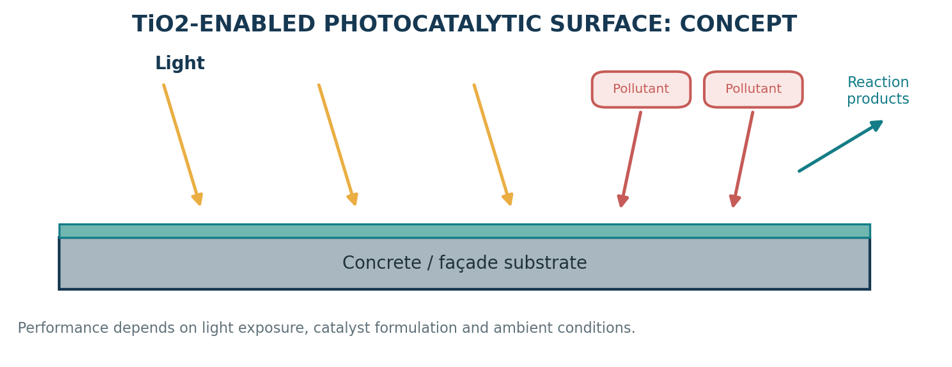
Titanium dioxide (TiO₂) is a widely used white pigment; particular formulations also exhibit photocatalytic behaviour. Under suitable illumination, TiO₂ can generate reactive species at a surface, potentially transforming selected deposited organic contaminants and certain pollutants. Activity varies with crystalline form, coatings, available light, pollutant concentrations, and exposure.
4.5.2 Self-cleaning behaviour and applications
Photocatalytic decomposition of selected deposits and changes in surface wettability may contribute to self-cleaning performance. Applications include façade finishes, cementitious panels, coated glass, paving and specialised surface treatments. However, products cannot be assumed to clean themselves or remove air pollution effectively under all site conditions.
4.5.3 Advantages and limitations
POTENTIAL BENEFITS | IMPORTANT LIMITATIONS |
Less visible surface soiling under suitable conditions | Requires suitable light and exposure |
Special functional coating characteristics | Results differ by formulation |
New façade maintenance options | Activity may decline due to contamination or wear |
Potential pollutant transformation | Environmental impacts require field verification |
4.6 Foamed Concrete
4.6.1 Definition and composition
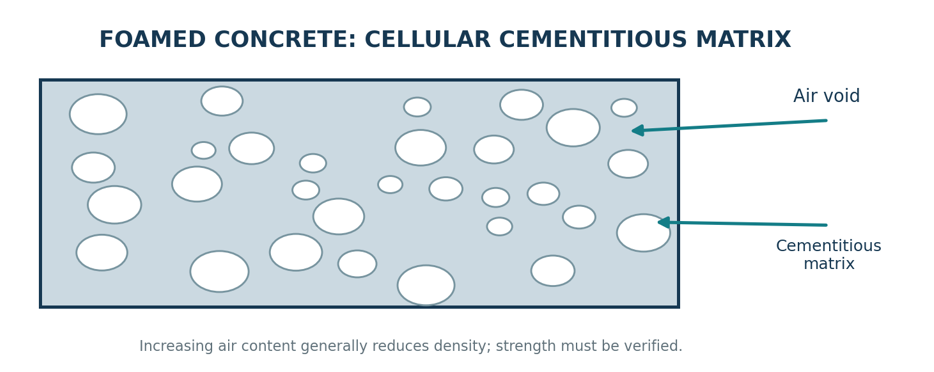
Foamed concrete is a lightweight cementitious material containing a deliberately introduced system of air voids, commonly produced using preformed foam mixed into a cementitious slurry or mortar. Depending on formulation, components may include cement, water, fine aggregate, foam, supplementary cementitious materials and admixtures.
.6.2 Manufacturing and key characteristics
- 7. Prepare a cementitious slurry using the specified mix.
- 8. Generate stable foam using a suitable foaming agent.
- 9. Mix foam into slurry to achieve specified fresh density.
- 10. Place material carefully to avoid excessive foam breakdown.
- 11. Allow adequate hardening and curing.
Air voids reduce density and may improve thermal resistance; however, lower-density mixes commonly have lower compressive strength. Performance must be selected to match the application rather than assuming all foamed concrete is structural.
4.6.3 Applications and constraints
Appropriate applications include roof screeds, levelling, void filling, trench reinstatement, non-load-bearing blocks and some precast products. Challenges include mix consistency, foam stability, shrinkage and strength–density trade-offs.
4.7 Graphene and Graphene-Based Construction Materials
4.7.1 Introduction
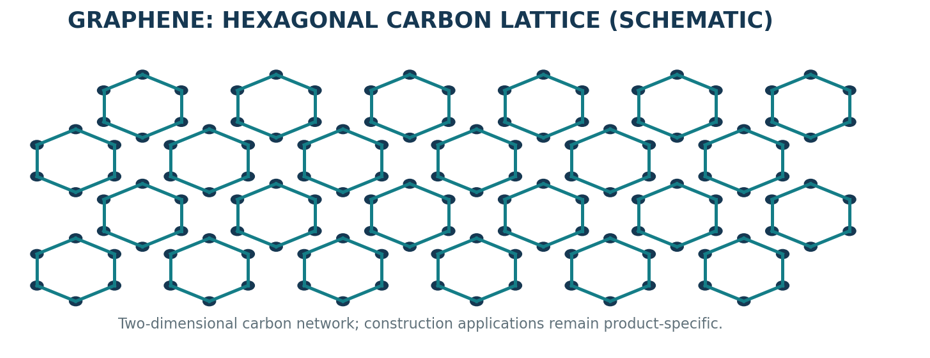
Graphene is a two-dimensional form of carbon in which atoms form a hexagonal lattice. It has exceptional intrinsic properties at the material scale. Research into graphene, graphene oxide, reduced graphene oxide and graphene nanoplatelets explores how selected additives may alter cementitious microstructure, crack resistance, electrical response, and coating behaviour.
4.7.2 Potential applications
Modified concrete. Some formulations show altered hydration, mechanical performance and durability; outcomes depend strongly on dispersion and dose.
Coatings. Research explores barrier and corrosion-protection applications.
Smart materials. Electrically conductive compositions are being investigated for sensing and monitoring functions.
4.7.3 Challenges
Practical limitations include cost, reliable manufacturing quality, dispersion difficulties, limited long-term field evidence, and lack of uniform specification approaches across emerging products. Graphene should therefore be understood as a developing technology, not a guaranteed performance enhancer.
4.8 High-Performance Concrete (HPC)
4.8.1 Definition
High-performance concrete is engineered to satisfy specified properties that may not be achievable consistently by conventional approaches. Performance requirements may include durability, workability, low permeability, mechanical resistance, or specialised exposure conditions. HPC is not synonymous with high-strength concrete: strength may be one target, but the required combination of properties defines performance.
4.8.2 Composition and characteristics
HPC commonly contains carefully selected cement, graded aggregates, water, supplementary cementitious materials and chemical admixtures. Controlled water–binder ratio, constituent compatibility, placement and curing are essential. Relevant characteristics may include carefully controlled workability, resistance to certain forms of deterioration and tailored mechanical properties.
4.8.3 Applications and limitations
HPC is used in suitable tall buildings, bridge components, marine and infrastructure works, precast elements and aggressive exposures. It may offer longer service life, but demands high-quality batching, placing, temperature control and curing. A high-performance mix can still crack or deteriorate if improperly detailed or executed.
4.9 Self-Compacting Concrete (SCC)
4.9.1 Meaning and three essential properties
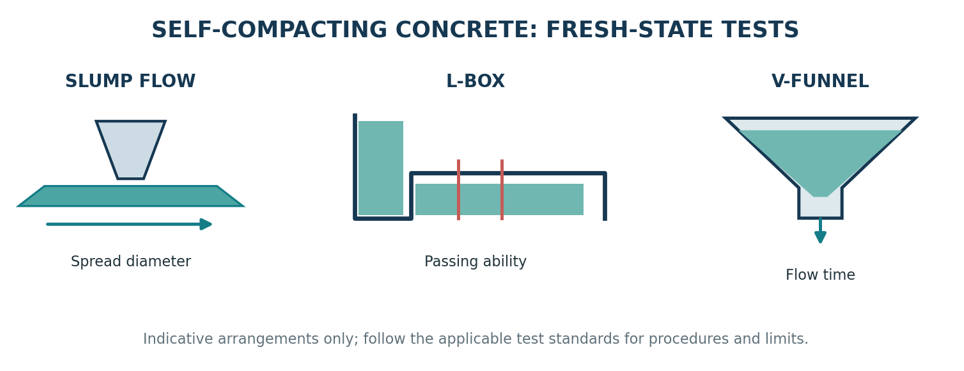
Self-compacting concrete is highly flowable concrete that fills formwork and passes congested reinforcement under its own weight without conventional mechanical vibration, while maintaining suitable stability against segregation.
Filling ability. Capacity to spread and fill the formwork under self-weight.
Passing ability. Ability to pass through narrow gaps and reinforcement without blocking.
Segregation resistance. Ability to remain reasonably homogeneous during transport and placement.
4.9.2 Typical constituents
SCC may include cement, fine and coarse aggregates, water, superplasticisers, mineral additions and viscosity-modifying admixtures where required. The selected powder content, aggregate grading and admixture balance influence fresh performance.
4.9.3 Test methods
TEST | PRINCIPAL OBSERVATION |
Slump flow | Unconfined spread of fresh SCC; an indicator of filling ability. |
T₅₀₀ time | Time to reach 500 mm diameter during slump flow, indicating flow behaviour. |
L-box | Flow past simulated reinforcement obstructions; passing ability. |
V-funnel | Discharge behaviour and flow time under a defined setup. |
Segregation resistance test | Tendency of fresh mix constituents to separate. |
4.9.4 Applications and limitations
SCC is useful for heavily reinforced walls and columns, exposed architectural concrete, precast components and forms with difficult access for vibration. It may reduce placement noise and effort and improve finish, but requires careful mix control, stability testing and attention to potentially high fresh-concrete formwork pressure.
4.10 High-Volume Fly Ash Concrete (HVFA)
4.10.1 Concept
High-volume fly ash concrete incorporates a substantial replacement of Portland cement by fly ash. In many technical discussions the replacement level is about 50% or more by binder mass, but definitions and practical limits vary by project and technical authority.
4.10.2 Composition and performance
The mixture generally includes Portland cement, fly ash, aggregates, water and suitable admixtures. Potential outcomes include reduced cement consumption and lower hydration heat in appropriate mixtures, with useful later-age performance. Some compositions may exhibit slower early strength gain and altered setting behaviour.
4.10.3 Architectural and construction application
Applications can include mass concrete, foundations and structural members where target performance is demonstrated. Designers must consider curing, construction-cycle duration, fly ash quality, strength at stripping and load-transfer stages, and environmental performance on a project-specific basis.
4.11 Condensed Silica Fume (CSF)
4.11.1 Introduction
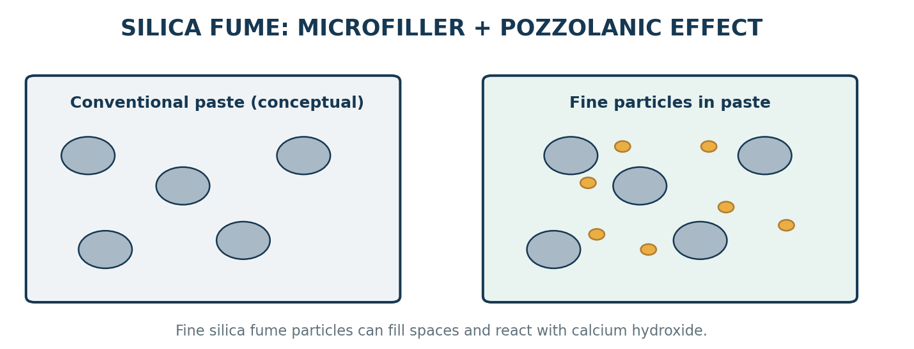
Condensed silica fume, also called microsilica, is a highly fine supplementary cementitious material typically collected during silicon metal or ferrosilicon alloy production. Its high surface area and reactive amorphous silica influence cementitious microstructure.
4.11.2 Two principal mechanisms
Microfiller action. Fine particles occupy some gaps among larger cement particles and contribute to a denser paste structure.
Pozzolanic reaction. Reactive silica combines with calcium hydroxide from cement hydration, helping form additional cementitious products.
4.11.3 Uses, benefits and precautions
Silica fume is used in selected high-performance and high-strength concretes, marine structures and bridge components. Properly designed systems may improve strength and reduce permeability, but fine particles can increase water demand and shrinkage sensitivity; admixture compatibility and good curing are important.
4.12 Self-Curing Concrete
4.12.1 Definition
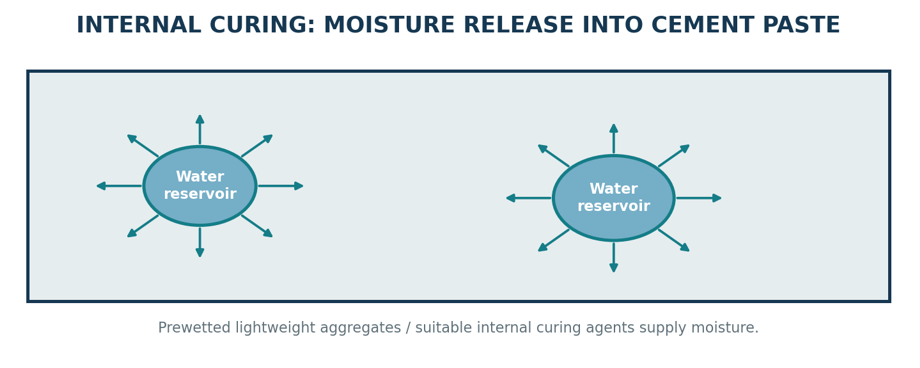
Self-curing concrete is commonly discussed through internal curing: extra moisture is retained within a concrete mixture to sustain hydration after placement. Suitable internal reservoirs may include prewetted lightweight aggregates or superabsorbent polymers. Internal curing is distinct from external wet curing and does not necessarily replace protection of exposed surfaces.
4.12.2 Working principle
As hydration uses water and internal humidity falls, the introduced reservoirs release available moisture to surrounding paste. In suitable mixtures this can help continued hydration and limit self-desiccation and autogenous shrinkage.
4.12.3 Uses and constraints
Potential benefits include hydration support and dimensional stability in selected mixtures. Risks include poor proportioning, changes in workability, unwanted absorption effects or reductions in strength when inappropriate internal curing agents are used.
4.13 Shrinkage-Free and Shrinkage-Compensating Concrete
4.13.1 Clarification of terminology
Concrete undergoes dimensional changes owing to moisture, chemical reactions and temperature. The expression “shrinkage-free concrete” is sometimes used in product descriptions but a truly zero-shrinkage material cannot generally be assumed. Engineering practice more commonly refers to shrinkage-reduced concrete, shrinkage-compensating concrete or specified non-shrink grouts.
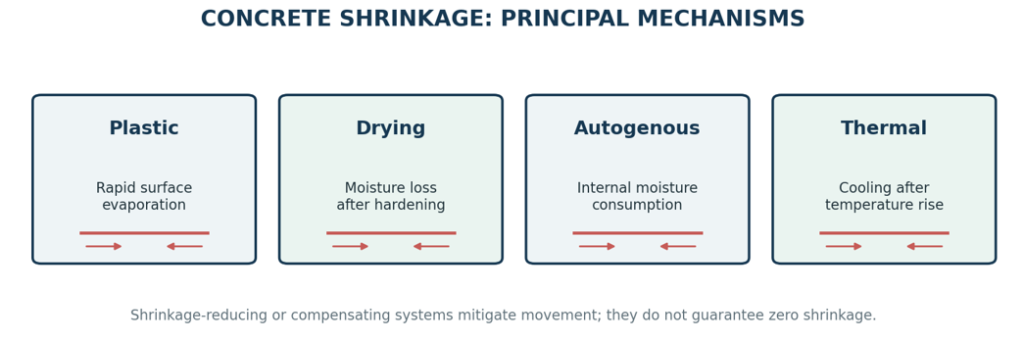
4.13.2 Types of shrinkage
Plastic shrinkage. Early moisture evaporation from the surface of fresh concrete can cause contraction and cracking.
Drying shrinkage. Moisture loss from hardened cement paste leads to dimensional change.
Autogenous shrinkage. Internal water consumption during hydration can cause volume reduction, especially in low water–binder systems.
Thermal contraction. Concrete contracts when temperature falls after a temperature rise.
4.13.3 Measures to control shrinkage
- . Limit unnecessary mixing water and use appropriate aggregate grading.
- . Provide suitable curing and evaporation control.
- . Consider shrinkage-reducing or shrinkage-compensating admixtures where technically appropriate.
- . Use internal curing in selected mixes.
- . Detail movement joints, reinforcement and restraint conditions to control crack risk.
Applications include industrial floors, repairs, equipment foundations and precast elements where dimensional stability matters.
4.14 Translucent Concrete
4.14.1 Definition and constituents
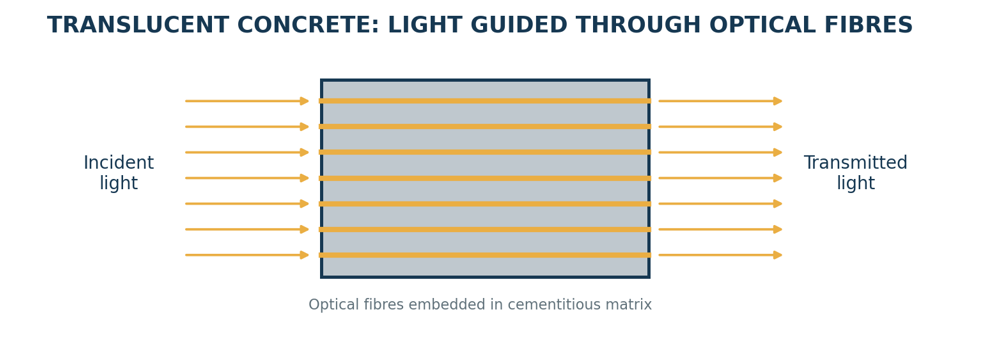
Translucent concrete is a cementitious composite incorporating optical fibres or other light-guiding inclusions to transmit some light from one face to another. Components generally include a suitable cementitious matrix, fine aggregate, water, light-transmitting elements and admixtures.
4.14.2 Working principle
Fibres embedded across the panel guide light from the illuminated face to the opposite face. The apparent light transmission depends on fibre size, density, alignment and panel thickness. Transmission does not imply that the cementitious matrix itself becomes optically transparent.
4.14.3 Applications and limitations
Suitable architectural uses include decorative interior partitions, reception backgrounds, feature walls, exhibition panels, public art and some façade features. Major challenges include high manufacturing cost, product-specific structural capability, detailing, and limited standardisation for many designs.
4.15 Sandwich Panels
4.15.1 Definition and configuration
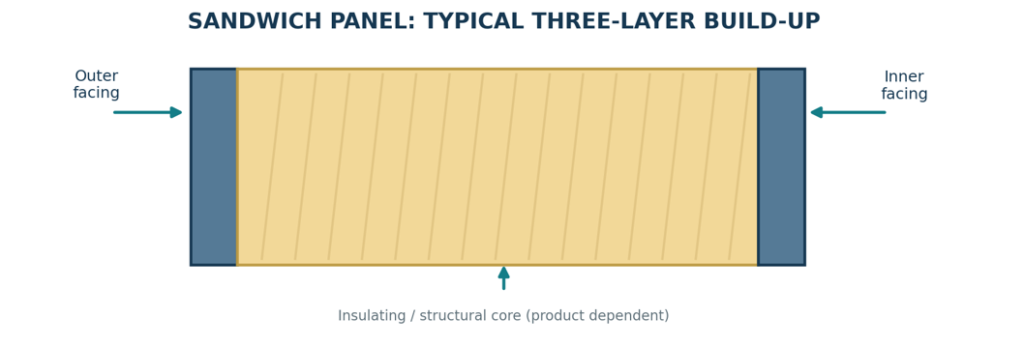
A sandwich panel is a layered component with two outer facings separated by a core material. Structural sandwich panels can exploit the separation of strong facings to resist bending, with the core maintaining spacing and transferring shear. Insulated wall and roof panels may prioritise thermal performance as well as enclosure and structural needs.
4.15.2 Common materials
Outer facings. May comprise coated steel, aluminium, fibre-reinforced composite or precast concrete.
Core. May include mineral wool, polyurethane, polyisocyanurate, EPS, XPS or another engineered material.
Connections. Adhesive bonds, mechanical anchors or specified connectors transfer forces and maintain the assembly; design varies greatly by product.
4.15.3 Types and applications
- . Metal-faced insulated panels: frequently used for industrial enclosure and roofing.
- . Precast concrete sandwich panels: concrete wythes separated by insulation with suitable interlayer connections.
- . Structural insulated panels: engineered outer facings bonded to an insulating core.
Applications include industrial buildings, cold storage, prefabricated envelopes, modular buildings, façades and selected partitions.
4.15.4 Advantages and limitations
ADVANTAGES | LIMITATIONS / RISKS |
Rapid prefabricated installation | Connections and joints require careful detailing |
Potential thermal insulation | Thermal bridges and moisture ingress may reduce performance |
Reduced on-site labour | Fire behaviour varies by core and full assembly |
Potential low weight | Damage to facings can affect durability |
TEACHING NOTE For sandwich panels, verify fire resistance, reaction-to-fire classification, wind resistance, structural capacity and thermal performance for the complete proposed assembly—not only the core material.
4.16 Comparative Analysis of Alternate Construction Materials
MATERIAL | KEY FEATURE | APPLICATION / MAIN CHECK |
Ferrocement | Thin mortar–mesh composite | Shells / mesh protection |
Fly ash bricks | Ash-based masonry unit | Walls / product testing |
AshCrete | Product-specific ash-based binder | Concrete units / validation |
Titanium dioxide | Photocatalytic surface function | Façades / exposure |
Foamed concrete | Low-density cellular matrix | Screeds / strength–density |
Graphene-based materials | Potential multifunctional performance | Emerging products / dispersion |
HPC | Designed performance properties | Structures / QC and curing |
SCC | Gravity-driven placement | Congested reinforcement / stability |
HVFA concrete | High fly ash replacement | Mass / early strength |
Silica fume concrete | Fine reactive SCM | Dense concrete / curing |
Self-curing concrete | Internal moisture supply | Hydration / mixture design |
Shrinkage-compensating | Dimensional stability approach | Repairs and floors / restraint |
Translucent concrete | Light-guiding inclusions | Feature panels / product strength |
Sandwich panels | Composite layered construction | Enclosures / joints and fire |
4.17 Selection Criteria for Alternate Construction Materials
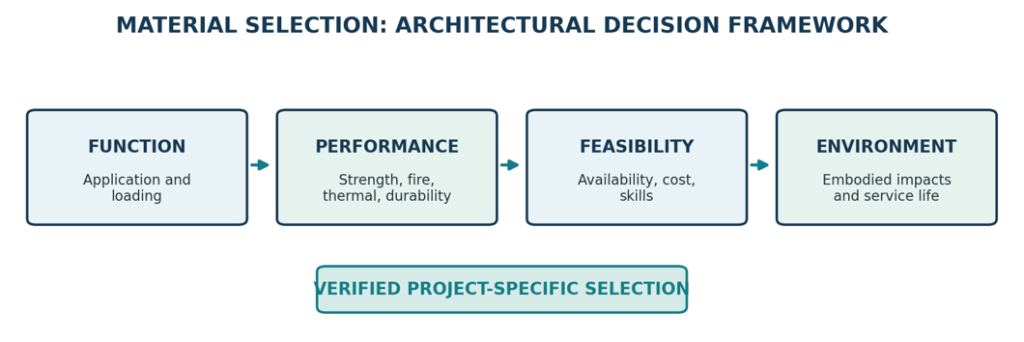
Material choice should be driven by the building brief, exposure conditions, construction method and verified performance, not novelty. A material is not necessarily sustainable, economical or durable merely because it is described as “advanced” or “alternative”.
Structural performance. Confirm strength, stiffness, loading and permissible use.
Durability. Evaluate moisture, corrosion, chemical exposure, weathering and service life.
Thermal performance. Assess conductivity, thermal bridging and the installed assembly.
Fire performance. Review both product and building-assembly performance.
Environment. Evaluate embodied impacts, resource extraction, transport, service life and end-of-life.
Cost. Compare installation, maintenance, replacement and whole-life costs.
Practical feasibility. Confirm local supply, quality control, skills, standard compliance and interface details.
4.18 Applications in Sustainable and Climate-Responsive Architecture
Alternative materials can support project sustainability goals only where they deliver verified benefits in a defined application. Fly ash bricks may utilise a suitable industrial by-product. Foamed concrete may reduce dead loads and contribute to insulation in selected systems. HVFA concrete can reduce Portland cement use, subject to performance requirements. Sandwich panels can contribute to thermal resistance, but their fire safety, joints and durability must be checked. TiO₂ coatings and graphene-containing systems represent specialised or emerging functions that warrant independent performance evaluation.
For climate-responsive architecture, the choice of wall, roof, floor and façade assemblies should account for local climate, orientation, exposure, solar heat gain, moisture management, and life-cycle consequences. No single material is universally best for all climatic regions and building types.
4.19 Examination-Oriented Questions
A. Short-answer questions (2.5 marks)
- 12. Define ferrocement and mention two applications.
- 13. What are fly ash bricks?
- 14. Define foamed concrete.
- 15. What is photocatalytic concrete?
- 16. Describe one potential application of graphene in cementitious materials.
- 17. What is high-performance concrete?
- 18. Define self-compacting concrete.
- 19. Explain high-volume fly ash concrete.
- 20. What is condensed silica fume?
- 21. State the principle of internal curing.
- 22. Explain shrinkage-compensating concrete.
- 23. Define translucent concrete.
- 24. State the basic components of a sandwich panel.
- 25. Mention two criteria for selecting alternative construction materials.
B. Descriptive questions (5 marks)
- 26. Explain the composition and construction of ferrocement with a labelled diagram.
- 27. Describe fly ash brick manufacture and compare it with fired clay brick production.
- 28. Explain foamed concrete composition, properties and applications.
- 29. Discuss the role and limitations of titanium dioxide and graphene in construction.
- 30. Differentiate high-performance concrete from conventional concrete.
- 31. Explain SCC properties and tests with sketches.
- 32. Describe HVFA concrete and discuss implications for construction scheduling.
- 33. Explain the contribution of condensed silica fume to concrete properties.
- 34. Illustrate the working principle of internal curing.
- 35. Discuss shrinkage mechanisms and control measures.
- 36. Explain the construction and uses of translucent concrete.
- 37. Draw a sandwich panel wall section and identify important connection, thermal and fire-safety considerations.
4.20 Chapter Learning Outcomes and Summary
After studying the unit, learners should be able to explain the composition and working principles of the prescribed materials; illustrate how key products are manufactured or assembled; compare their performance and construction limitations; and recommend materials for an architectural application using defensible criteria.
The chapter demonstrates that alternative building materials encompass several different approaches: industrial by-product utilisation (fly ash bricks, HVFA concrete), thin cementitious composites (ferrocement), specialist concretes (HPC, SCC, self-curing and shrinkage-control systems), lightweight and composite construction (foamed concrete and sandwich panels), and emerging functional products (TiO₂ coatings, graphene and translucent concrete). Selection should be based on verified project-specific suitability rather than claimed technological advancement alone.
4.21 References and Further Reading
- . Duggal, S. K. Building Materials. New Age International.
- . Neville, A. M. Properties of Concrete. Pearson.
- . Mehta, P. K., and Monteiro, P. J. M. Concrete: Microstructure, Properties, and Materials. McGraw-Hill.
- . Chudley, R., and Greeno, R. Building Construction Handbook. Routledge.
- . Naaman, A. E. Ferrocement and Laminated Cementitious Composites. Techno Press.
- . IS 12894 — Fly Ash Lime Bricks — Specification.
- . IS 456 — Plain and Reinforced Concrete.
- . IS 10262 — Concrete Mix Proportioning Guidelines.
- . IS 3812 — Pulverized Fuel Ash for Use as Pozzolana.
- . IS 15388 — Silica Fume — Specification.
- . EFNARC technical publications on self-compacting concrete.
How useful was this post?
Click on a star to rate it!
Average rating 0 / 5. Vote count: 0
No votes so far! Be the first to rate this post.


