
Niu Lai: How the ‘Worst Animated Film’ Became China’s Most Unlikely Box-Office Sensation

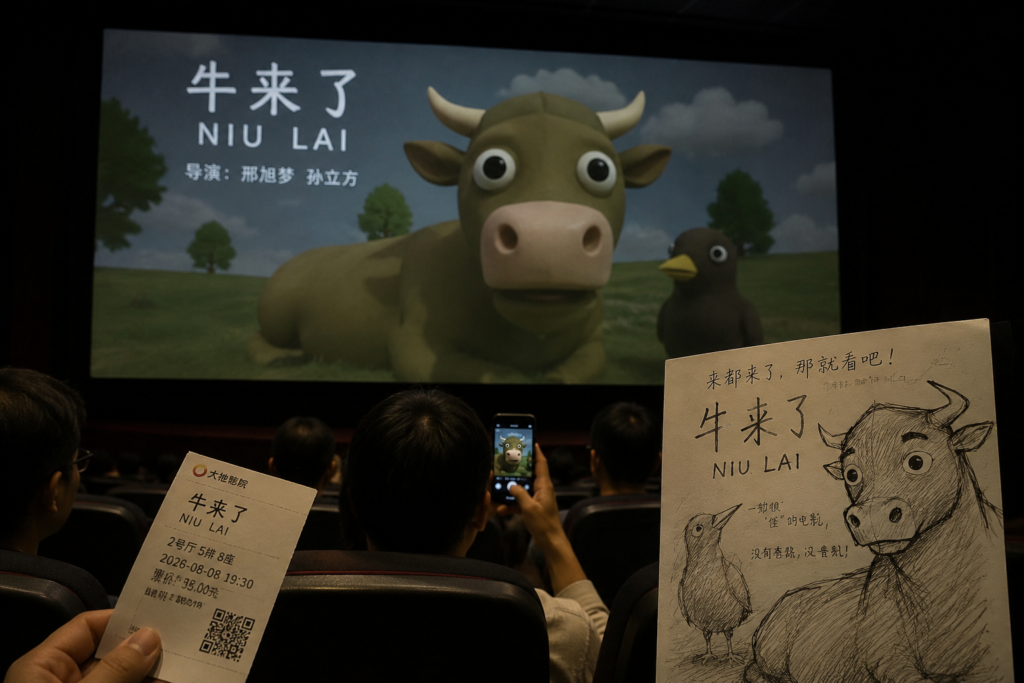
A film with crude animation, awkward-looking characters, almost no conventional marketing and an obscure storyline would normally have little chance against major studio releases.
Niu Lai has somehow done exactly the opposite.
The Chinese animated film, translated variously as The Cow Is Coming or The Bull Is Coming, has become one of the strangest cinema stories of 2026. Instead of being destroyed by criticism of its rudimentary animation, the film appears to have benefited from it.
People are not necessarily buying tickets because they have been told that Niu Lai is good.
They are buying tickets because the internet has told them that it is extraordinarily bad and they want to experience it themselves.
That distinction may explain one of the most fascinating examples of meme-driven entertainment in recent years.
From Almost Nobody Watching It to Millions at the Box Office
Niu Lai was released in China on 5 August 2026.
Its beginning could hardly have been less spectacular.
Reports indicate that the film earned only around 7,700–10,000 yuan during its first 10 days, with fewer than 300 people reportedly buying tickets during the period. On particularly quiet days, its revenue reportedly dropped to only a few hundred yuan.
There was little conventional publicity surrounding it. No major promotional campaign. No celebrity-driven media tour. Even a conventional trailer was reportedly absent.
For most independent films, this would have been the end of the story.
Then the internet discovered Niu Lai.
Clips began circulating online, drawing attention to the film’s rudimentary 3D graphics, unusual characters, voice performances and strange visual atmosphere.
Criticism soon turned into comedy.
Comedy turned into memes.
And the memes created curiosity.
Within days, audiences who might otherwise never have heard of the film began going to cinemas simply to answer one question:
Can this movie really be as strange as everyone says?
By 18 August, Associated Press reported that its cumulative box office had reached approximately 17.1 million yuan ($2.5 million).
Its transformation from an almost invisible release into a national conversation had been remarkably fast.
The ‘So Bad It’s Good’ Economy
The phenomenon surrounding Niu Lai demonstrates something increasingly important about contemporary internet culture:
Negative attention is still attention — and under the right conditions, attention can become economic value.
Traditional entertainment marketing tries to convince audiences that something is worth watching.
The viral marketing surrounding Niu Lai effectively communicated the opposite.
People were being told that the film was bizarre, technically crude and difficult to explain.
Yet every negative description increased the mystery.
The result was a powerful form of curiosity marketing.
When thousands of users joke about a film being unbelievably bad, a new audience begins wondering what could possibly justify such a reaction.
Eventually, watching the film becomes less about consuming a cinematic product and more about participating in an internet event.
That is precisely where Niu Lai appears to have crossed an important threshold.
The movie became a meme before it became a hit.
Made by Two People Over Five Years
Another part of the story has strengthened its appeal.
Chinese media reports cited by international outlets say that Niu Lai was created over approximately five years by just two people — Xin Yumeng and his mother, Sun Lifan.
They reportedly took on multiple creative roles in the production.
Associated Press noted that it had not independently verified all details surrounding the reported two-person production, so this aspect of the story should be treated with appropriate caution.
Nevertheless, the narrative of a tiny production competing for public attention alongside enormous studio films has become central to the movie’s appeal.
It creates a classic underdog story.
On one side are sophisticated contemporary productions backed by large teams, advanced visual-effects pipelines and substantial marketing machinery.
On the other is a peculiar animated cow.
And somehow, the cow became one of the most discussed characters on the Chinese internet.
The Unexpected AI Connection
There is another reason the story has resonated internationally.
Niu Lai has arrived during an increasingly intense debate over AI-generated creative content.
Generative AI can now produce illustrations, videos, voices, music and animations at extraordinary speed. Social platforms are consequently filling with increasingly polished AI-generated material.
But technical polish does not necessarily produce emotional connection.
Against this background, the obvious imperfections of Niu Lai have acquired an unexpected meaning.
Some viewers have interpreted its crude appearance almost as evidence of human authorship.
The argument is fascinating.
A few years ago, audiences might have viewed technically poor animation simply as poor animation.
In 2026, however, obvious imperfections can potentially signal something else:
A human actually struggled to make this.
That does not automatically make the work artistically successful. Nor does it mean audiences suddenly prefer poor craftsmanship.
But it reveals an emerging cultural tension.
As artificially generated imagery becomes easier to produce, traces of human imperfection may themselves acquire value.
Niu Lai accidentally sits at the centre of that debate.
When Imperfection Becomes Authenticity
Digital culture has spent years pursuing increasingly flawless imagery.
Higher resolution.
Better rendering.
More realistic animation.
Smoother motion.
More sophisticated visual effects.
Artificial intelligence accelerates that trajectory dramatically.
Yet audiences may also be developing a counter-reaction to constant visual perfection.
Niu Lai offers almost the opposite experience.
Its limitations are visible.
Its strangeness is visible.
The labour behind it feels visible.
This does not mean that poor-quality production will become a new formula for commercial success. Thousands of poorly produced films disappear without anyone noticing them.
What matters here is the combination of imperfection + authenticity + humour + curiosity + social participation.
Together, those ingredients created something that money alone cannot guarantee:
a cultural moment.
The Audience Became the Marketing Department
Perhaps the most important lesson from Niu Lai concerns marketing.
The film apparently began with almost none.
Once it became a meme, however, thousands of internet users effectively began promoting it for free.
Every mocking clip advertised the movie.
Every sarcastic review advertised the movie.
Every meme advertised the movie.
Every person telling a friend, “You have to see how terrible this is,” advertised the movie.
This creates a fascinating reversal of conventional marketing.
Normally:
Marketing → Awareness → Curiosity → Ticket Sale
With Niu Lai, the process looked more like:
Criticism → Meme → Viral Sharing → Curiosity → Ticket Sale
The audience effectively became an unpaid promotional network.
And because the recommendation often came through humour between friends rather than formal advertising, it potentially carried something conventional marketing struggles to manufacture: social credibility.
Watching Became a Social Experience
The phenomenon also shows that audiences increasingly consume cultural products for reasons beyond their intrinsic quality.
Sometimes people watch something because it is excellent.
Sometimes because it is controversial.
Sometimes because everyone is talking about it.
And increasingly, people watch because they want to understand the meme.
This is particularly significant among younger internet audiences.
If a film becomes part of online conversation, watching it provides entry into that conversation.
The ticket therefore purchases more than 86 minutes of animation.
It purchases context.
Now the viewer understands the jokes.
Now the viewer can post a reaction.
Now the viewer can recommend it sarcastically to another friend.
Consumption becomes participation.
The Film’s Name Added Another Layer to the Meme
Even the title contributed to the phenomenon.
Niu Lai (牛来) can be understood literally in terms of a bull/cow arriving. Online users have also connected the phrase humorously with the idea of a bull market.
That allowed the movie to escape the boundaries of cinema discussion and enter wider meme culture.
The more meanings internet communities attach to a cultural object, the easier it becomes for that object to spread into communities that would otherwise have little interest in it.
At that stage, the film is no longer simply a film.
It becomes reusable internet material.
Is Niu Lai Actually a Success?
Financially, its transformation is difficult to ignore.
Artistically, the answer is more complicated.
Its popularity should not automatically be interpreted as evidence that conventional standards of animation, storytelling and filmmaking no longer matter.
Indeed, much of its popularity appears to depend precisely upon audiences recognising how far it departs from those standards.
The irony is central to the experience.
Remove the internet conversation surrounding Niu Lai, and the film might have remained virtually unknown.
Its success therefore belongs not only to cinema but also to the emerging relationship between cinema and algorithmic culture.
What Creators and Marketers Can Learn From Niu Lai
The wrong lesson would be:
“Make something terrible and it will go viral.”
That would misunderstand the phenomenon completely.
Bad content usually remains bad content — and invisible.
The more useful lesson is that contemporary audiences respond strongly to things that are distinctive, discussable and participatory.
Niu Lai became impossible to confuse with another film.
Its visual shortcomings gave audiences something to discuss. Its tiny production story provided an underdog narrative. Its bizarre reputation created curiosity. Memes made participation easy. The debate over AI gave its handmade imperfections additional cultural significance.
Together, those factors produced virality.
For digital creators, therefore, the lesson may not be to pursue imperfection deliberately.
It may be to pursue identity.
In an online environment flooded with technically competent content, being memorable can sometimes matter more than being flawless.
A Strange Warning for the AI Age
There is a larger cultural question hiding behind the jokes.
What happens when almost anyone can generate visually impressive content?
For decades, technical sophistication itself signalled resources, skill and professionalism.
Generative AI is weakening that relationship.
Beautiful images are becoming easier to create.
Smooth animation is becoming easier.
Professional-looking graphics are becoming easier.
As technical perfection becomes increasingly accessible, audiences may begin placing greater value on qualities that remain harder to automate:
authenticity, personality, eccentricity, intention and human experience.
That does not make Niu Lai a masterpiece.
But it makes the response to Niu Lai culturally interesting.
From Box-Office Disaster to Internet Phenomenon
On paper, Niu Lai possessed almost none of the ingredients associated with a mainstream hit.
No major marketing campaign.
Rudimentary animation.
An unconventional story.
A tiny reported production team.
A disastrous opening.
Yet the internet transformed precisely those weaknesses into the film’s identity.
People laughed at it.
Then they shared it.
Then other people became curious.
Then they bought tickets.
And somewhere during that process, a film that almost nobody was watching became one of the most unexpected entertainment stories of the summer.
Perhaps that is the real significance of Niu Lai.
It is not simply the story of a “bad movie” becoming successful.
It is a case study in how memes can become marketing, criticism can become curiosity, audiences can become promoters, and imperfection can become strangely valuable in an age increasingly dominated by artificial perfection.
In the AI era, Niu Lai may have stumbled upon a paradox that creators everywhere should pay attention to:
When perfection becomes easy to manufacture, imperfection can become remarkably difficult to ignore.


