
UNIT 4: | AR503 | NANOMATERIALS AND NANOCOMPOSITES

4.1 Why Nanotechnology Matters in Construction
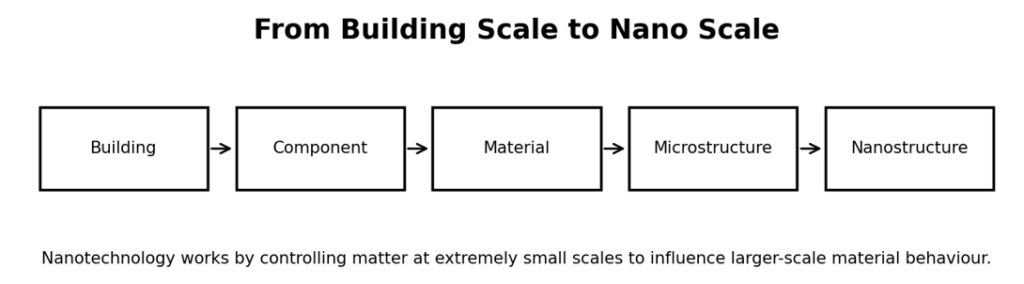
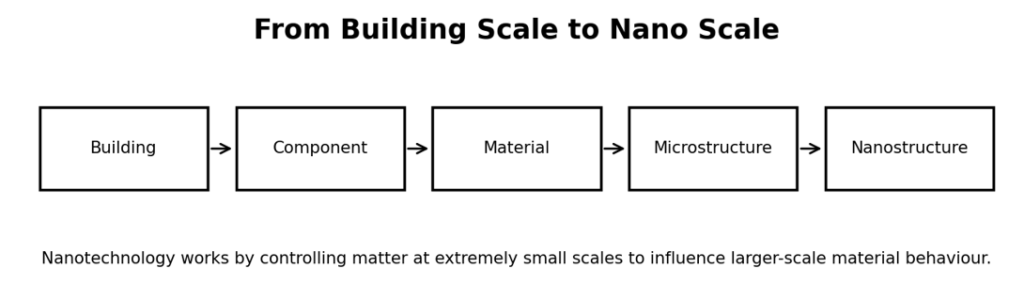
Building materials appear solid and uniform to the naked eye, but their performance is strongly influenced by structures and reactions occurring at much smaller scales. Pores in cement paste, the surface chemistry of glass, corrosion processes on steel, and heat transfer through insulation are all affected by micro- and nano-scale features. Nanotechnology attempts to understand or deliberately modify these very small features so that the material performs differently at the building scale.
A nanometre is one billionth of a metre (10⁻⁹ m). Materials with features in the nanoscale range can exhibit behaviour different from the same substance in bulk form because surface area becomes very large relative to volume and because atomic or molecular interactions become increasingly important. In construction, this does not mean that an entire wall is ‘nano-sized’. It means that nano-sized particles, coatings, fibres or structures are incorporated into conventional building materials to influence their behaviour.
Core learning chain |
NANO-SCALE CHANGE → MICROSTRUCTURE / SURFACE CHANGE → PROPERTY CHANGE → CONSTRUCTION PERFORMANCE → BUILDING APPLICATION |
4.2 Nanomaterials and Nanocomposites
A nanomaterial contains particles, fibres, layers or structural features whose dimensions are in the nanoscale range. A nanocomposite is a composite material in which at least one constituent or reinforcing phase operates at the nanoscale. The base material may still be familiar—cement, glass, polymer, coating or metal—but the nano-addition modifies its behaviour.
For example, concrete remains a cement-based composite, but the addition of nano-silica can modify hydration products and refine the pore structure. A glass pane remains glass, but a nano-scale surface coating can change how water spreads or how the surface interacts with light and contaminants. Thus, nanotechnology often works by improving an existing material rather than replacing it completely.
Form | Basic idea | Construction relevance |
Nanoparticles | Extremely fine particles dispersed in a matrix or coating. | Cement modification, pigments, photocatalytic surfaces. |
Nanotubes / nanofibres | Very slender nano-scale structures with high aspect ratio. | Reinforcement, conductivity, sensing research. |
Nanocoatings | Very thin functional surface layers. | Self-cleaning, anti-corrosion, water-repellent or optical functions. |
Nanoporous materials | Materials with extremely fine pore networks. | High-performance thermal insulation such as aerogel-based products. |
Nanocomposites | Conventional matrix combined with nano-scale constituent. | Improved mechanical, durability, thermal or functional performance. |
4.3 How Nanomaterials Are Produced: Top-Down and Bottom-Up
Nanomaterials can be produced through two broad approaches. In the top-down approach, a larger material or surface is progressively reduced, patterned or processed until nano-scale features are obtained. Mechanical milling, lithographic techniques and some forms of etching follow this general logic.
In the bottom-up approach, the process begins with atoms, ions or molecules and builds larger nano-scale structures through chemical reactions, precipitation, sol-gel processes, vapour deposition or self-assembly. The distinction is useful because it explains whether the nano-structure is created by breaking down something larger or by assembling something from smaller units.
Exam-ready distinction |
TOP-DOWN: larger material → smaller nano-feature. BOTTOM-UP: atoms/molecules → assembled nano-structure. Give one or two suitable examples after stating this basic difference. |
4.4 Why Properties Change at the Nano Scale
Two ideas help explain much of nanomaterial behaviour. First, nano-sized particles have a very high surface-area-to-volume ratio. A greater proportion of their atoms are near the surface and can participate in reactions or interactions. Second, when dimensions become extremely small, the structure and movement of electrons, molecules or interfaces can differ from bulk behaviour.
In construction, these effects may be used to increase reactivity, refine pores, change wettability, improve barrier performance, alter optical behaviour, or create electrical sensitivity. However, the effect is not automatically beneficial: performance depends on particle type, dosage, dispersion, compatibility and manufacturing control.
Important caution |
‘Nano’ does not automatically mean ‘better’. Poor dispersion can cause agglomeration, excessive dosage can harm workability or performance, and some nano-products require careful health, environmental and cost assessment. |
4.5 Nano-Silica in Cement and Concrete
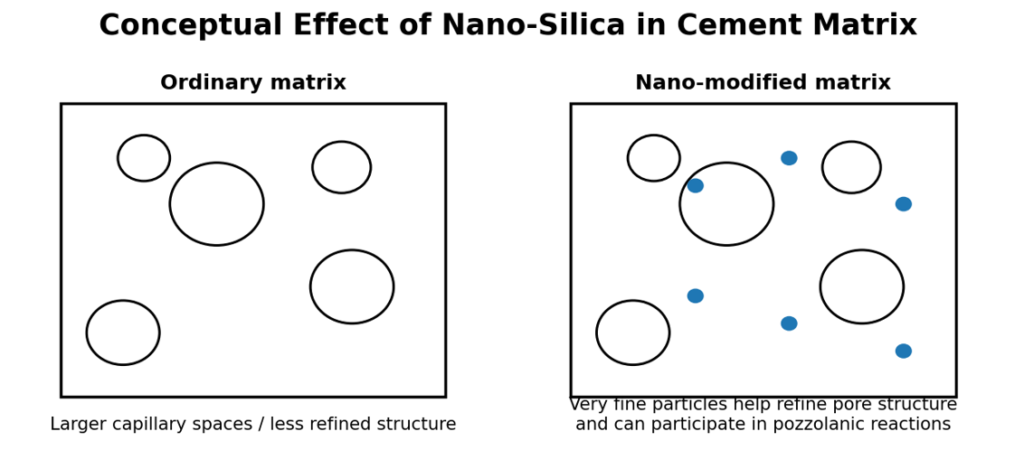
Concrete contains pores and interfaces at many scales. The cement paste develops strength mainly through hydration products, but capillary pores and the interfacial transition zone around aggregates can remain relatively weak or permeable. Nano-silica is extremely fine amorphous silica that can influence this microstructure.
Its very small particles can act as fillers within fine voids and may also provide nucleation sites that support the development of hydration products. In addition, reactive silica can participate in pozzolanic reactions with calcium hydroxide, contributing to additional calcium-silicate-hydrate (C–S–H), the principal binding phase associated with strength in hydrated cement paste. The combined effect can refine the pore structure and produce a denser matrix when the material is properly proportioned and dispersed.
4.5.1 What Does This Mean at Building Scale?
A denser and better-refined matrix can reduce pathways through which water and aggressive agents move. Depending on mixture design and curing, nano-silica-modified concrete may therefore show improvements in early strength, later strength, permeability resistance or durability-related properties. The architect should connect this microscopic change with applications where compactness and durability are valuable.
There are also practical limitations. Nano-silica has very high surface area and can increase water demand or reduce workability if the mix is not adjusted. Uniform dispersion is essential because agglomerated particles do not provide the intended nano-scale benefit.
Understand, then remember |
Nano-silica → filler/nucleation + pozzolanic contribution → refined pore structure / more C–S–H → denser cement matrix → possible improvement in strength and durability. |
4.6 Titanium Dioxide (TiO₂) and Self-Cleaning Building Surfaces
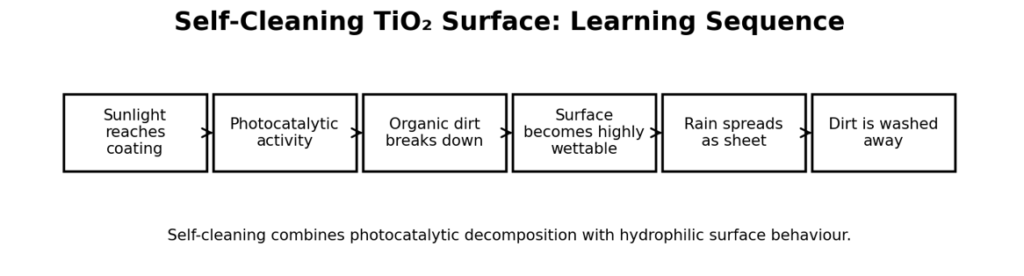
Titanium dioxide is widely discussed in architectural nanotechnology because it can provide photocatalytic and hydrophilic surface behaviour. When suitable TiO₂ is exposed to light, photocatalytic reactions can help decompose certain organic contaminants on the surface. At the same time, the surface can become highly wettable, allowing water to spread more uniformly rather than forming isolated droplets.
When rainwater spreads as a thin sheet, loosened or decomposed dirt can be carried away more effectively. This is the basis of many self-cleaning glass, tile and façade concepts. The material does not make a building permanently maintenance-free; rather, it can reduce the adhesion or persistence of certain contaminants under suitable exposure conditions.
Exam trap to avoid |
Do not write only ‘TiO₂ repels water’. Many self-cleaning TiO₂ surfaces work through photocatalytic activity together with high wettability/hydrophilicity, so water can spread across the surface. |
4.7 Carbon Nanotubes (CNTs)
Carbon nanotubes are cylindrical nano-scale structures formed from graphitic carbon arrangements. They have extremely high aspect ratio and are known for exceptional mechanical properties at the material scale, along with useful electrical and thermal characteristics. Single-walled and multi-walled CNTs are two commonly discussed forms.
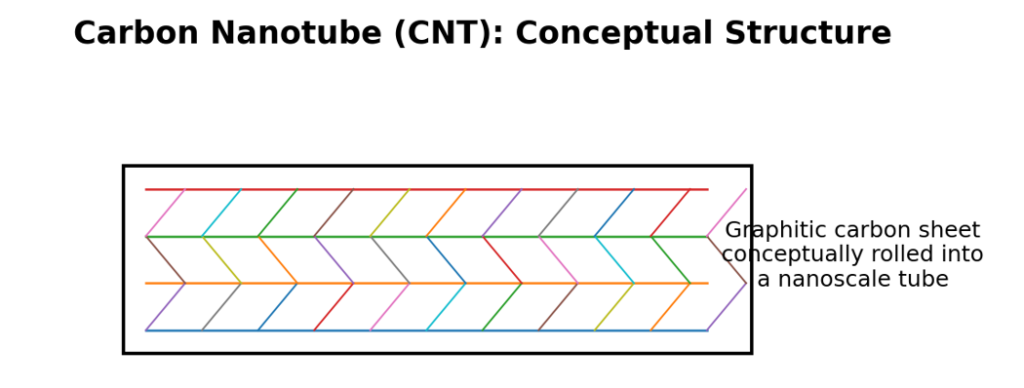
In cementitious materials, CNTs are investigated as nano-reinforcement capable of bridging very fine cracks and modifying mechanical behaviour. Their electrical conductivity4.8 Nano-Modified Steel and Metals
Nanotechnology can influence metals through nano-structured coatings, surface treatments or microstructural control. For building construction, the most understandable application is surface protection. Corrosion begins at the exposed surface, so improving the barrier or chemical behaviour of that surface can help protect the metal beneath.
Nano-enhanced coatings may be formulated to improve barrier properties, scratch resistance, hydrophobicity or corrosion resistance. Some research also investigates nano-structured steels with refined grains to improve combinations of strength and toughness. These applications should be understood as controlled material engineering rather than as a separate category of ‘nano steel buildings’.
Architectural connection |
For steel and aluminium, nanotechnology is often most visible at the SURFACE: protective, anti-corrosion, dirt-resistant or functional coatings can extend service performance of façades, frames and exposed components. |
4.9 Nano-Modified Glass
Glass is a major architectural surface, so nano-scale coatings are especially useful because they can add functions without substantially changing the basic pane. Depending on coating chemistry, glass may be designed for self-cleaning behaviour, improved solar control, anti-reflective performance, water management or other specialised functions.
Self-cleaning glass demonstrates an important principle of advanced materials: instead of increasing thickness or adding mechanical equipment, a very thin functional surface can change how the building envelope interacts with sunlight, water and dirt. This can reduce maintenance demand in locations where access for cleaning is difficult.
Nano-enabled glass function | Building significance |
Self-cleaning surface | Can reduce adhesion/persistence of certain contaminants and assist rain washing. |
Solar-control coating | Can modify transmission/reflection of solar radiation depending on coating design. |
Anti-reflective surface | Can reduce unwanted surface reflection in selected glazing applications. |
Hydrophilic / hydrophobic control | Changes how water spreads or beads on the surface. |
4.10 Nanotechnology in Wood and Timber Products
Wood is hygroscopic and biologically derived, so moisture, ultraviolet radiation, fungi, insects and surface weathering affect its service life. Nano-scale treatments and coatings are investigated to modify surface water behaviour, improve UV resistance, provide antimicrobial action or enhance fire-related performance.
The learning point is similar to glass and metal: a thin functional treatment can change the interaction between the material and its environment. However, compatibility with the porous and anisotropic nature of wood is important, and claims about durability or toxicity should be evaluated for the specific commercial product.
4.11 Nano-Enabled Thermal Insulation: Aerogel
Aerogels are highly porous, extremely lightweight materials in which much of the liquid phase of a gel has been replaced by gas while retaining a fine solid network. Their nano-scale pore structure restricts heat transfer, allowing very low thermal conductivity compared with many conventional solid materials.
In architecture, silica aerogel may be used in translucent insulation systems, blankets, renders or specialised glazing products. Its major attraction is high thermal resistance with relatively small thickness, which can be useful where space is limited or daylight/translucency is desired.
Aerogel products are not automatically economical for every wall. Cost, fragility of some forms, installation method and product-specific fire/moisture performance must be considered. The architect should therefore view aerogel as a high-performance option for particular conditions rather than a universal replacement for conventional insulation.
Concept chain |
Nano-porous structure → restricted solid/gas heat transfer → very low thermal conductivity → high insulation performance at comparatively small thickness. |
4.12 Nano-Coatings and Functional Building Surfaces
A coating is often only a small fraction of the thickness of the material it protects, yet it controls the first interaction with the environment. Nanotechnology makes this surface layer even more functionally important. Nano-coatings may be engineered for water repellence, anti-corrosion performance, scratch resistance, antimicrobial behaviour, photocatalytic action or optical control.
Hydrophobic surfaces encourage water to bead, while hydrophilic surfaces encourage water to spread. These are opposite behaviours, but both can be useful. A water-repellent façade may use hydrophobicity to reduce wetting, while photocatalytic self-cleaning glass may use hydrophilicity to allow rainwater to form a washing sheet.
Surface behaviour | What water does | Possible building purpose |
Hydrophobic | Water forms droplets / beads more readily. | Water-repellent surfaces and reduced wetting in suitable systems. |
Hydrophilic | Water spreads more readily across the surface. | Self-cleaning concepts where sheet-like washing is useful. |
Photocatalytic | Light activates surface reactions. | Breakdown of certain organic contaminants/pollutants. |
Barrier coating | Restricts movement of moisture/ions/oxygen. | Protection against corrosion or environmental attack. |
4.13 Nanotechnology and Fire Protection
Nanomaterials can be incorporated into polymers, coatings and composite systems to influence their behaviour during fire. Nano-clays and other nano-additives may improve barrier formation, reduce heat release or support char development in certain formulations. The exact mechanism depends on the material system and should not be generalised to every nano-additive.
In building applications, fire performance must always be established through tested and code-compliant products. A nano-additive is not a substitute for required fire resistance ratings, compartmentation or tested assemblies. For students, the important concept is that nano-scale additives can modify the thermal degradation and barrier behaviour of a material.
4.14 Structural Health Monitoring (SHM) and Smart Materials
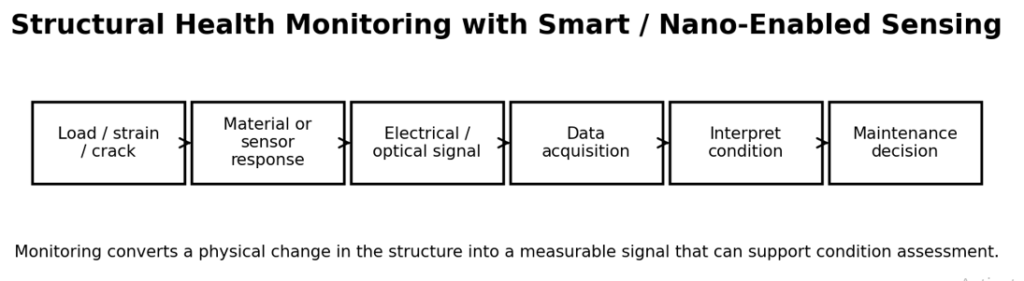
Structural health monitoring aims to observe changes in a structure so that deterioration, excessive strain or damage can be detected and assessed. Conventional SHM may use strain gauges, accelerometers, fibre-optic sensors and other devices. Nanotechnology adds the possibility of very small sensors or self-sensing materials whose electrical properties change when the material is strained or cracked.
For example, a cement composite containing a conductive network of carbon-based nano-materials may show a change in electrical resistance as cracks or strain alter the conductive pathways. If calibrated and measured correctly, this response can provide information about structural condition.
Key distinction |
A smart/self-sensing material does not ‘repair’ the structure simply because it detects damage. SENSING, DIAGNOSIS and SELF-HEALING are different functions and should not be confused. |
4.15 Applications of Nanotechnology in Buildings
Nanotechnology is most useful when it solves a defined performance problem. On a high-rise façade, a self-cleaning surface may reduce difficult maintenance. In concrete exposed to aggressive conditions, nano-modification may be investigated to refine permeability and durability. In a retrofit, a high-performance thin insulation may solve a space constraint. In structural monitoring, conductive nano-composites may support condition sensing.
Building problem | Nano-enabled response | Example application |
Façade soiling | Photocatalytic / controlled-wettability surface | Self-cleaning glass, tile or façade coating. |
Concrete permeability / microstructure | Nano-silica modification | High-performance cementitious systems. |
Limited insulation thickness | Nano-porous insulation | Aerogel blanket, translucent panel or specialised render. |
Metal corrosion | Nano-enhanced protective coating | Exposed steel/aluminium components. |
Need for condition monitoring | Conductive/self-sensing composite | Research and specialised SHM applications. |
Wood weathering | Functional nano-coating/treatment | Selected exterior or interior timber products. |
4.16 Advantages, Limitations and Responsible Use
The promise of nanotechnology lies in achieving significant functional change using very small quantities or very thin layers. It can create multifunctional materials—for example, a façade surface that performs its normal enclosure function while also assisting cleaning or environmental protection.
However, advanced performance must be balanced against cost, constructability, durability of the nano-function, compatibility with other materials, availability, maintenance and end-of-life considerations. Health and environmental effects also require responsible handling, particularly for free nano-powders that can become airborne during manufacturing or mixing.
Potential advantage | Corresponding concern |
High performance with small additions | Precise dosage and dispersion may be difficult. |
Multifunctional surfaces | Function may degrade with weathering or contamination. |
Improved material efficiency | Initial cost can be high. |
Smart/sensing capability | Requires calibration, data interpretation and system integration. |
New material behaviour | Health/environmental impacts and safe handling must be assessed. |
Professional judgement |
Do not select a nanomaterial because the word ‘nano’ sounds advanced. Select it only when verified performance solves a project requirement better than reasonable alternatives. |
4.17 Connecting the Unit: One Learning Map
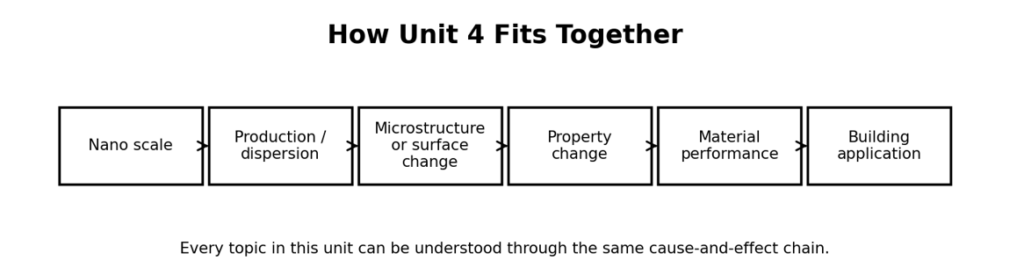
This learning map is more useful than memorising isolated products. For nano-silica, the nano-scale addition changes cement microstructure and can influence strength/permeability. For TiO₂, the surface chemistry changes and produces photocatalytic/hydrophilic behaviour. For aerogel, nano-scale porosity changes heat transfer. For CNT-based sensing, a conductive nano-network makes electrical response sensitive to physical change.
4.18 Examination-Oriented Revision
4.18.1 High-Value Concepts to Understand
- Why nano-scale materials can behave differently from bulk materials.
- Difference between nanomaterial and nanocomposite.
- Difference between top-down and bottom-up production.
- How nano-silica can modify the cement matrix and why dispersion matters.
- How TiO₂-based self-cleaning surfaces combine photocatalysis and wettability.
- Why CNTs are attractive for reinforcement and self-sensing, and why dispersion is a challenge.
- How nano-coatings add functions to steel, aluminium, glass and wood.
- Why nano-porous aerogel can provide high thermal insulation.
- How self-sensing materials relate to structural health monitoring.
4.18.2 Important 5-Mark Questions
- Define nanomaterials and nanocomposites. Explain their significance in building construction with examples.
- Explain top-down and bottom-up approaches for production of nanomaterials with a suitable diagram.
- Explain the role and mechanism of nano-silica in cement and concrete. State advantages and limitations.
- Explain the working principle and architectural applications of TiO₂-based self-cleaning surfaces.
- Write a note on carbon nanotubes and discuss their potential applications in construction.
- Discuss nanotechnology applications in glass, steel/aluminium and wood.
- Explain aerogel as a nano-enabled thermal insulation material.
- Explain the concept of structural health monitoring using smart or nano-enabled materials.
4.18.3 Short / 2½-Mark Questions
- What is a nanometre? Define a nanomaterial.
- Differentiate top-down and bottom-up approaches.
- What is a nanocomposite?
- State two effects of nano-silica in cementitious materials.
- What is photocatalysis in the context of TiO₂ surfaces?
- Differentiate hydrophobic and hydrophilic surfaces.
- What are CNTs? State two construction-related potentials.
- What is aerogel and why is it a good thermal insulator?
- What is meant by a self-sensing material?
4.18.4 How to Write a Strong 5-Mark Answer
Begin with a short definition or concept paragraph. Then explain the mechanism—what changes at the nano scale and how that changes material behaviour. Add a neat labelled diagram or flowchart. Follow with 3–5 building applications or performance benefits and finish with one or two limitations. This structure demonstrates understanding rather than memorisation.
Final revision formula |
For every nanomaterial ask five questions: WHAT IS IT? → HOW IS THE NANO-FEATURE CREATED/ADDED? → WHAT CHANGES IN THE MATERIAL? → WHAT PROPERTY IMPROVES/CHANGES? → WHERE IS THAT USEFUL IN A BUILDING? |
4.19 Suggested Reading
These notes are designed for examination-oriented learning. For detailed material properties, dosage, testing procedures, exposure limits and product-specific performance, students should consult standard construction-material texts, peer-reviewed literature, relevant BIS/ISO/ASTM standards and verified manufacturer technical data. Nano-products vary widely; project decisions should be based on tested performance ra
How useful was this post?
Click on a star to rate it!
Average rating 0 / 5. Vote count: 0
No votes so far! Be the first to rate this post.


